
"If there is one area where businesses can save themselves enormous amounts of stress, it is pre-production."
Video can be one of the most powerful marketing investments a business makes — but only if you get as much value from the production as possible.
A professionally produced brand film, commercial, testimonial, corporate video or social media campaign can do far more than simply live on your website. With the right planning, a single video shoot can generate weeks or even months of marketing content, support multiple advertising platforms, strengthen your brand and ultimately help drive sales.
Here are four practical ways to increase the ROI of your next video production.
1. Generate More Than Just the Main Video
One of the biggest opportunities businesses miss is failing to create shoulder content during a video production.
Shoulder content is supplementary content captured around your primary shoot. It doesn’t necessarily require a separate production day, which makes it one of the most cost-effective ways to increase the value of your video production budget.
Think about it this way: you’ve already booked the location, assembled the crew, arranged the lighting and brought your talent together. Why not get as much useful content as possible while everyone is there?
Capture professional photography alongside the video
A professional film shoot often creates an incredible visual environment.
The lighting is carefully designed. The location is dressed. The talent is prepared. Your products are looking their best. Your brand is already being represented at a professional level.
That makes the shoot an excellent opportunity to capture high-quality photography at the same time.
A photographer working alongside the video crew can capture:
Website photography
Social media images
LinkedIn content
Advertising photography
Product photography
Employee portraits
Behind-the-scenes images
Campaign imagery
Website banners and hero images
Instead of booking another photography shoot a few weeks later, you can potentially capture much of this content on the same day.
Capture vertical social media content
Your main production might be designed around a traditional 16:9 commercial or corporate video, but that doesn’t mean your social media content needs to wait.
Between takes, there may be opportunities to capture vertical 9:16 content specifically for Instagram Reels, TikTok, YouTube Shorts and other mobile-first platforms.
This doesn’t have to be complicated.
A member of the production team can capture short clips on a phone or dedicated camera while the main crew prepares for the next shot. These could include quick interviews, product demonstrations, informal moments with the team, tips from an expert or short promotional messages.
The key is to think about the entire shoot as a content-generation opportunity, rather than simply a way to produce one finished video. We produced these 9x16 Vertical Ads for Social Media for a client at one shoot, in addition to a traditional 16x9 Video Business Card.

Create behind-the-scenes content
People love seeing what happens behind the curtain.
A polished commercial might show the final result, but behind-the-scenes footage gives audiences a glimpse into the people, process and personality behind the brand.
That content can be particularly useful for social media because it tends to feel more immediate and authentic than a highly polished advertisement.
You might capture:
The crew setting up a scene
Employees preparing for an interview
A funny moment between takes
Lighting and camera setups
A product being demonstrated
The transformation of a location
The making of a commercial
Short interviews with employees
And because you’re already paying for the production to happen, much of this content can be captured without requiring another full production day.
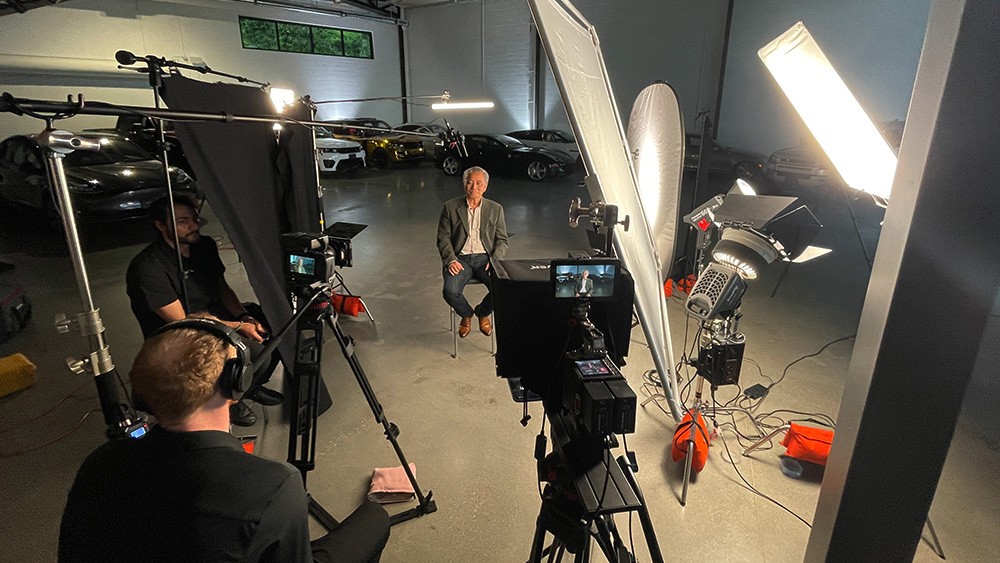
Create short-form cutdowns
Your main video can also become the foundation for an entire library of shorter pieces.
A two-minute corporate film could potentially produce several 15-second, 30-second or 60-second social media edits.
A customer testimonial might become multiple individual clips, each focused on a different benefit.
A product commercial could be adapted into several different advertising variations.
This is where professional video production starts to behave less like a single asset and more like a content library.
Before your next shoot, ask your video production company:
“What else can we capture while we’re already here?”
You may be surprised by how much additional value can be created without dramatically increasing your production budget.
2. Start Preparing 3–4 Weeks Before the Shoot
If there is one area where businesses can save themselves enormous amounts of stress, it is pre-production.
Too often, video projects don’t really begin until the week of the shoot.
By then, everyone is rushing.
The script may still be changing. Interview subjects may not know what they are going to say. Locations may not be finalized. The production team may not have all the information they need. And important creative decisions are being made under pressure.
That’s a recipe for unnecessary risk.
There is an old saying:
A pinch of preparation prevents a pound of pain.
The more complex the production, the more important this becomes.

Give your production company enough time to help you prepare
Ideally, your video production company should be involved three to four weeks before the shoot, rather than simply receiving the final details a few days beforehand.
This gives everyone time to think through the project properly.
Your production team can help identify questions such as:
What is the objective of the video?
Who is the audience?
Where will the video be used?
What should the audience do after watching?
Who needs to appear on camera?
What locations are required?
What equipment will be necessary?
What needs to be prepared on set?
What additional content should be captured?
What aspect ratios and deliverables are required?
Are there legal, branding or approval considerations?
What potential problems can be solved before production day?
These questions might seem simple, but answering them early can have a major impact on the finished product.
Good pre-production saves money
It is tempting to think of pre-production as an additional expense.
In reality, good pre-production is one of the best ways to protect your production budget.
Imagine arriving on location and discovering that an important interview subject hasn’t prepared.
Or realizing that the location doesn’t work for the planned shots.
Or discovering that the video needs to be delivered in multiple formats that weren’t discussed.
Or realizing halfway through production that you need additional footage that wasn’t scheduled.
Those problems can lead to additional crew hours, additional shooting days, rushed decisions and compromises in the final edit.
A little planning beforehand can prevent all of that.
The goal isn’t to make the production unnecessarily complicated. It’s the opposite.
Good preparation makes production easier, calmer and more efficient.
At Truth & Beauty Video Production, we believe the production company should be more than the crew that shows up with cameras on shoot day. A good production partner should help you think through the project before the cameras ever start rolling.
3. Have a Deployment Strategy Before You Shoot
A great video that nobody sees isn’t a great marketing investment.
Before producing your video, you should have a clear idea of where the finished content is going to live and how you plan to use it.
This is your deployment strategy.
Are you putting the video on your website?
Running it as a Google or YouTube advertisement?
Using it on LinkedIn?
Launching a social media campaign?
Running paid advertising on Instagram or TikTok?
Sending it to prospective customers?
Using it at trade shows or conferences?
The answer matters because it can affect how your video should be produced.

Tell your production company where the video will be used
Different platforms have different requirements, and your production team should know about those requirements before the shoot, not after the edit is finished.
For example, TikTok, Instagram Reels and YouTube Shorts are built around vertical 9:16 video.
YouTube’s traditional video format is generally 16:9.
Other platforms and advertising placements may call for square or alternative formats.
Even if your primary use is simply your website, tell your video production company.
A good production team can then consider composition, framing and coverage during the shoot so that the footage can be adapted later.
This is much better than finishing a beautiful 16:9 video and then discovering you need to crop it dramatically into a vertical advertisement.
Consider allocating part of your budget to marketing
Another common mistake is putting the entire budget into production and nothing into distribution.
Depending on your goals, it may make sense to allocate part of your overall video marketing budget toward someone who understands digital advertising, media buying or campaign strategy.
A marketing expert can help determine:
Which platforms are worth advertising on
Which audience you should target
Which video lengths to test
Which creative approaches may perform best
How much budget to allocate to each platform
Which versions of your video should be tested
How to measure conversions
Which audiences should see which messages
This is particularly important when the video is being created to generate measurable business results.
You don’t want your strategy to be:
“Let’s make a great video and figure out what to do with it afterward.”
Instead, think:
“What do we want this video to accomplish, and what content do we need to create to accomplish it?”
That simple change in thinking can dramatically improve the return on your production investment.
4. Correctly Value What the Video Could Do for Your Business
Perhaps the most important question to ask before producing a video is:
What is this video actually worth to us?
There is no universal “correct” video production budget.
A video that is worth $5,000 to one business could be worth $100,000 to another.
The right budget depends on the potential return.
At Truth & Beauty Video Production, we work at many different scales. Some projects involve a single filmmaker. Others involve larger crews of 10, 15 or even 20 people working on significant productions and sound stages.
Neither approach is inherently better.
The important question is whether the scale of the production makes sense for the opportunity.

Think about potential return, not just production cost
Imagine a company is launching a new product and believes a successful video advertising campaign could generate an additional $2 million in profit.
It makes sense to consider a substantially larger production investment if the video has a realistic chance of contributing to that result.
Now imagine another business is producing a simple promotional video that it expects to generate approximately $10,000 in additional profit.
It probably doesn’t make sense to spend $100,000 producing that video.
The goal isn’t to spend as much as possible.
The goal is to spend the appropriate amount for the opportunity.
This is one reason major brands can justify enormous advertising productions. Their campaigns may be reaching millions of people and supporting products worth millions or even billions of dollars.
A small local business may have completely different economics.
And that’s okay.
Bigger isn’t always better
There is sometimes a misconception that professional video production means having a massive crew, expensive cameras, huge lighting packages and elaborate sets.
Those things can be valuable when the project requires them.
But they aren’t automatically necessary.
A small business might get an incredible return from a carefully planned one-day shoot with a small crew.
Another company might genuinely need a larger production with multiple locations, actors, art direction, specialized lighting, a larger camera department and extensive post-production.
The production should be designed around the business objective, not the other way around.
That’s why we work at different scales at Truth & Beauty Video Production.
We don’t believe every client needs a 20-person crew.
And we don’t believe every project should be squeezed into a one-person production either.
The right production is the one that gives the business the best opportunity to achieve its goal.
The Best Video Investment Isn’t Always the Biggest One
Ultimately, increasing the ROI of your video production isn’t simply about negotiating a lower production price.
It’s about getting more business value from the money you spend.
That means thinking beyond the final video.
It means asking what other content can be captured during the shoot.
It means giving your production team enough time to prepare properly.
It means knowing where the content will be deployed before production begins.
And it means understanding how much the finished video could realistically contribute to your business.
A well-planned video production can become much more than a single asset.
One shoot can produce a hero video, multiple social media cutdowns, vertical advertisements, photography, behind-the-scenes footage, employee content, website imagery and a library of material that can be used throughout an entire marketing campaign.
That’s when video production starts to become a genuine business investment rather than simply a production expense.
Planning a Video Production in Vancouver?
At Truth & Beauty Video Production, we produce video for businesses at a range of scales, from lean one-day productions to larger commercial and corporate shoots.
Whether you need a corporate video, brand film, customer testimonial, social media campaign, commercial or video advertising content, we’ll help you determine the right production approach for your goals and budget.
The best place to start isn’t with the question:
“How much does a video cost?”
Start with:
“What do we want this video to accomplish?”
Once you know that, the right production strategy becomes much easier to determine.
Truth & Beauty Video Production — Vancouver Video Production for Businesses That Want Their Content to Work Harder.
Video can be one of the most powerful marketing investments a business makes — but only if you get as much value from the production as possible.
A professionally produced brand film, commercial, testimonial, corporate video or social media campaign can do far more than simply live on your website. With the right planning, a single video shoot can generate weeks or even months of marketing content, support multiple advertising platforms, strengthen your brand and ultimately help drive sales.
Here are four practical ways to increase the ROI of your next video production.
1. Generate More Than Just the Main Video
One of the biggest opportunities businesses miss is failing to create shoulder content during a video production.
Shoulder content is supplementary content captured around your primary shoot. It doesn’t necessarily require a separate production day, which makes it one of the most cost-effective ways to increase the value of your video production budget.
Think about it this way: you’ve already booked the location, assembled the crew, arranged the lighting and brought your talent together. Why not get as much useful content as possible while everyone is there?
Capture professional photography alongside the video
A professional film shoot often creates an incredible visual environment.
The lighting is carefully designed. The location is dressed. The talent is prepared. Your products are looking their best. Your brand is already being represented at a professional level.
That makes the shoot an excellent opportunity to capture high-quality photography at the same time.
A photographer working alongside the video crew can capture:
Website photography
Social media images
LinkedIn content
Advertising photography
Product photography
Employee portraits
Behind-the-scenes images
Campaign imagery
Website banners and hero images
Instead of booking another photography shoot a few weeks later, you can potentially capture much of this content on the same day.
Capture vertical social media content
Your main production might be designed around a traditional 16:9 commercial or corporate video, but that doesn’t mean your social media content needs to wait.
Between takes, there may be opportunities to capture vertical 9:16 content specifically for Instagram Reels, TikTok, YouTube Shorts and other mobile-first platforms.
This doesn’t have to be complicated.
A member of the production team can capture short clips on a phone or dedicated camera while the main crew prepares for the next shot. These could include quick interviews, product demonstrations, informal moments with the team, tips from an expert or short promotional messages.
The key is to think about the entire shoot as a content-generation opportunity, rather than simply a way to produce one finished video. We produced these 9x16 Vertical Ads for Social Media for a client at one shoot, in addition to a traditional 16x9 Video Business Card.
Create behind-the-scenes content
People love seeing what happens behind the curtain.
A polished commercial might show the final result, but behind-the-scenes footage gives audiences a glimpse into the people, process and personality behind the brand.
That content can be particularly useful for social media because it tends to feel more immediate and authentic than a highly polished advertisement.
You might capture:
The crew setting up a scene
Employees preparing for an interview
A funny moment between takes
Lighting and camera setups
A product being demonstrated
The transformation of a location
The making of a commercial
Short interviews with employees
And because you’re already paying for the production to happen, much of this content can be captured without requiring another full production day.
Create short-form cutdowns
Your main video can also become the foundation for an entire library of shorter pieces.
A two-minute corporate film could potentially produce several 15-second, 30-second or 60-second social media edits.
A customer testimonial might become multiple individual clips, each focused on a different benefit.
A product commercial could be adapted into several different advertising variations.
This is where professional video production starts to behave less like a single asset and more like a content library.
Before your next shoot, ask your video production company:
“What else can we capture while we’re already here?”
You may be surprised by how much additional value can be created without dramatically increasing your production budget.
2. Start Preparing 3–4 Weeks Before the Shoot
If there is one area where businesses can save themselves enormous amounts of stress, it is pre-production.
Too often, video projects don’t really begin until the week of the shoot.
By then, everyone is rushing.
The script may still be changing. Interview subjects may not know what they are going to say. Locations may not be finalized. The production team may not have all the information they need. And important creative decisions are being made under pressure.
That’s a recipe for unnecessary risk.
There is an old saying:
A pinch of preparation prevents a pound of pain.
The more complex the production, the more important this becomes.
Give your production company enough time to help you prepare
Ideally, your video production company should be involved three to four weeks before the shoot, rather than simply receiving the final details a few days beforehand.
This gives everyone time to think through the project properly.
Your production team can help identify questions such as:
What is the objective of the video?
Who is the audience?
Where will the video be used?
What should the audience do after watching?
Who needs to appear on camera?
What locations are required?
What equipment will be necessary?
What needs to be prepared on set?
What additional content should be captured?
What aspect ratios and deliverables are required?
Are there legal, branding or approval considerations?
What potential problems can be solved before production day?
These questions might seem simple, but answering them early can have a major impact on the finished product.
Good pre-production saves money
It is tempting to think of pre-production as an additional expense.
In reality, good pre-production is one of the best ways to protect your production budget.
Imagine arriving on location and discovering that an important interview subject hasn’t prepared.
Or realizing that the location doesn’t work for the planned shots.
Or discovering that the video needs to be delivered in multiple formats that weren’t discussed.
Or realizing halfway through production that you need additional footage that wasn’t scheduled.
Those problems can lead to additional crew hours, additional shooting days, rushed decisions and compromises in the final edit.
A little planning beforehand can prevent all of that.
The goal isn’t to make the production unnecessarily complicated. It’s the opposite.
Good preparation makes production easier, calmer and more efficient.
At Truth & Beauty Video Production, we believe the production company should be more than the crew that shows up with cameras on shoot day. A good production partner should help you think through the project before the cameras ever start rolling.
3. Have a Deployment Strategy Before You Shoot
A great video that nobody sees isn’t a great marketing investment.
Before producing your video, you should have a clear idea of where the finished content is going to live and how you plan to use it.
This is your deployment strategy.
Are you putting the video on your website?
Running it as a Google or YouTube advertisement?
Using it on LinkedIn?
Launching a social media campaign?
Running paid advertising on Instagram or TikTok?
Sending it to prospective customers?
Using it at trade shows or conferences?
The answer matters because it can affect how your video should be produced.
Tell your production company where the video will be used
Different platforms have different requirements, and your production team should know about those requirements before the shoot, not after the edit is finished.
For example, TikTok, Instagram Reels and YouTube Shorts are built around vertical 9:16 video.
YouTube’s traditional video format is generally 16:9.
Other platforms and advertising placements may call for square or alternative formats.
Even if your primary use is simply your website, tell your video production company.
A good production team can then consider composition, framing and coverage during the shoot so that the footage can be adapted later.
This is much better than finishing a beautiful 16:9 video and then discovering you need to crop it dramatically into a vertical advertisement.
Consider allocating part of your budget to marketing
Another common mistake is putting the entire budget into production and nothing into distribution.
Depending on your goals, it may make sense to allocate part of your overall video marketing budget toward someone who understands digital advertising, media buying or campaign strategy.
A marketing expert can help determine:
Which platforms are worth advertising on
Which audience you should target
Which video lengths to test
Which creative approaches may perform best
How much budget to allocate to each platform
Which versions of your video should be tested
How to measure conversions
Which audiences should see which messages
This is particularly important when the video is being created to generate measurable business results.
You don’t want your strategy to be:
“Let’s make a great video and figure out what to do with it afterward.”
Instead, think:
“What do we want this video to accomplish, and what content do we need to create to accomplish it?”
That simple change in thinking can dramatically improve the return on your production investment.
4. Correctly Value What the Video Could Do for Your Business
Perhaps the most important question to ask before producing a video is:
What is this video actually worth to us?
There is no universal “correct” video production budget.
A video that is worth $5,000 to one business could be worth $100,000 to another.
The right budget depends on the potential return.
At Truth & Beauty Video Production, we work at many different scales. Some projects involve a single filmmaker. Others involve larger crews of 10, 15 or even 20 people working on significant productions and sound stages.
Neither approach is inherently better.
The important question is whether the scale of the production makes sense for the opportunity.
Think about potential return, not just production cost
Imagine a company is launching a new product and believes a successful video advertising campaign could generate an additional $2 million in profit.
It makes sense to consider a substantially larger production investment if the video has a realistic chance of contributing to that result.
Now imagine another business is producing a simple promotional video that it expects to generate approximately $10,000 in additional profit.
It probably doesn’t make sense to spend $100,000 producing that video.
The goal isn’t to spend as much as possible.
The goal is to spend the appropriate amount for the opportunity.
This is one reason major brands can justify enormous advertising productions. Their campaigns may be reaching millions of people and supporting products worth millions or even billions of dollars.
A small local business may have completely different economics.
And that’s okay.
Bigger isn’t always better
There is sometimes a misconception that professional video production means having a massive crew, expensive cameras, huge lighting packages and elaborate sets.
Those things can be valuable when the project requires them.
But they aren’t automatically necessary.
A small business might get an incredible return from a carefully planned one-day shoot with a small crew.
Another company might genuinely need a larger production with multiple locations, actors, art direction, specialized lighting, a larger camera department and extensive post-production.
The production should be designed around the business objective, not the other way around.
That’s why we work at different scales at Truth & Beauty Video Production.
We don’t believe every client needs a 20-person crew.
And we don’t believe every project should be squeezed into a one-person production either.
The right production is the one that gives the business the best opportunity to achieve its goal.
The Best Video Investment Isn’t Always the Biggest One
Ultimately, increasing the ROI of your video production isn’t simply about negotiating a lower production price.
It’s about getting more business value from the money you spend.
That means thinking beyond the final video.
It means asking what other content can be captured during the shoot.
It means giving your production team enough time to prepare properly.
It means knowing where the content will be deployed before production begins.
And it means understanding how much the finished video could realistically contribute to your business.
A well-planned video production can become much more than a single asset.
One shoot can produce a hero video, multiple social media cutdowns, vertical advertisements, photography, behind-the-scenes footage, employee content, website imagery and a library of material that can be used throughout an entire marketing campaign.
That’s when video production starts to become a genuine business investment rather than simply a production expense.
Planning a Video Production in Vancouver?
At Truth & Beauty Video Production, we produce video for businesses at a range of scales, from lean one-day productions to larger commercial and corporate shoots.
Whether you need a corporate video, brand film, customer testimonial, social media campaign, commercial or video advertising content, we’ll help you determine the right production approach for your goals and budget.
The best place to start isn’t with the question:
“How much does a video cost?”
Start with:
“What do we want this video to accomplish?”
Once you know that, the right production strategy becomes much easier to determine.
Truth & Beauty Video Production — Vancouver Video Production for Businesses That Want Their Content to Work Harder.
MORE STORIES
MORE STORIES
FROM THE STUDIO
FROM THE STUDIO

Insights
"The challenge was to make the shoot efficient without making it feel rushed or compromising the quality of the final content."

Insights
"Kickstarter is an unusually demanding environment for video because viewers need to understand a product quickly while also connecting with the people and story behind it."
Insights
"If there is one area where businesses can save themselves enormous amounts of stress, it is pre-production."